← Playbooks
PlaybookProduct ops
From stars to sprint: the feedback-to-backlog operating model
Collecting feedback is a feature. Shipping because of it is an operating model. This playbook is the second thing: the roles, cadences, standards, and metrics that turn a live feedback stream into work that ships — without the PM becoming a full-time ticket transcriber.
July 21, 2026 · Playbook · 10 min read
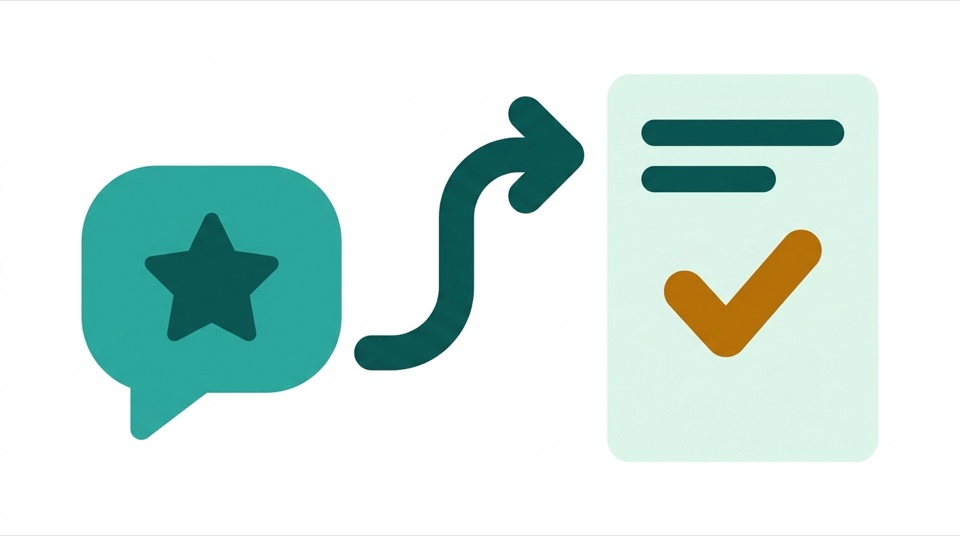
The pipeline, named
Five stages, each with an owner and an exit condition. If any stage has no owner, feedback pools there and rots — the suggestion-box death.
| Stage | Owner | Exit condition |
|---|
| 1. Capture — in-context ratings, comments, attachments | The widget (automated) | Item lands in the stream with page, product, rating context |
| 2. Triage — status, assignee, tags | Triage owner (rotating) | Every item older than the SLA has a status and a home |
| 3. Synthesis — clustering into themes | AI copilot | Recurring pain appears as a theme with volume, trend, average rating |
| 4. Drafting — backlog items with evidence | AI copilot proposes · PO disposes | Accepted, edited, or rejected — by a human, always |
| 5. Shipping — tickets in Jira/ADO | Delivery team | Cited feedback auto-marked actioned; loop measurably closed |
Triage cadence and ownership
- Rotate the triage owner weekly per product (or product group). Permanent triage duty burns one person out and gives everyone else amnesia about what users say; rotation spreads the user-contact around the team — which is half the point.
- SLA: every item gets a status within 5 business days. Status, not solution: new → acknowledged → in-triage → actioned / declined / duplicate. Declined is a first-class outcome — an honest no beats a polite backlog purgatory.
- 15 minutes daily beats 2 hours monthly. The daily skim also catches operational smoke (a spike on one page usually means a release broke something) that a monthly batch reads as history. Wire the feedback-spike alert to the triage owner so the smoke finds them.
- Track triage health — untriaged backlog size and time-to-status — and put it on the same dashboard as the product metrics. A rotting queue is a leading indicator of a team that has stopped listening.
Standards for AI-drafted items
An AI copilot drafting backlog items is a force multiplier exactly as long as the drafts are held to a standard. Ours:
- Citations or it didn't happen. Every draft links the real comments behind it. A PM reviews evidence, not claims — and a draft citing two comments competes honestly with one citing forty. (The full pipeline: from a 2-star rating to a Jira ticket.)
- Acceptance criteria must be testable. "Export works reliably" is not a criterion; "selecting 'last quarter' with >10k rows produces a CSV within 30s" is. Reject drafts that wave.
- The PO gate is real. Accept, edit, or reject — but never auto-forward. Rejection rate is a health metric in both directions: near 0% means rubber-stamping; over ~60% means the clustering needs tuning.
- Edits are normal. The draft is a strong starting point, not a verdict. POs who treat drafts as raw material get the speed without surrendering judgment.
Jira / Azure DevOps setup
- Per-product mapping: each Morvero product maps to a Jira project (or ADO area path) once, by an admin. Wrong-project tickets are how integrations lose trust in week one.
- Auto-open on accept: accepting a draft creates the ticket — summary, user story, acceptance criteria, evidence links — so grooming starts from substance. No copy-paste step, because every manual step is where pipelines die.
- Auto-action on accept: the cited feedback flips to actioned in the same transaction, which is what makes the closure metrics below trustworthy rather than aspirational.
- Don't sync status backwards at first. Start with one-way (Morvero → tracker). Bidirectional sync is a v2 luxury; one-way is reliable on day one.
Metrics: prove the loop closes
| Metric | Healthy looks like |
|---|
| Feedback-to-status time | Median under 5 business days, no long tail |
| Actioned share | Share of feedback cited by accepted work — the real "we listen" number; single digits at first, growing quarterly |
| Feedback-to-ship time | Median days from first citing comment to the ticket closing — the loop's total latency |
| Post-ship rating delta | The page's rating trend after the fix ships — the only metric users ever see, and the one that makes the whole model worth running |
Review these monthly next to usage and sentiment. When the post-ship rating delta goes positive on three fixes in a row, show that slide to everyone who ever called feedback collection a vanity feature.
Run it on Morvero: stages 1–5 are built in — capture with context, triage with statuses and health analytics, AI theme clustering, evidence-cited drafts behind a PO gate, and Jira/ADO tickets that open themselves on accept.
Start free and connect Jira in-app; the widget takes
one script tag.
 morvero